The Digital Twin isn't just for engineers. It's your next sales tool.
When a product is too complex to explain, technical simulation isn't a luxury — it's the only way to turn a promise into concrete evidence. The numbers back it up.
The market is growing at 48% per year. Your sales team is still on the sidelines.
The Digital Twin is one of the fastest-growing industrial technologies of recent years. Yet in the vast majority of companies, it remains confined to R&D and maintenance. Sales is left out — and that is precisely the competitive advantage available to those who decide to change course.
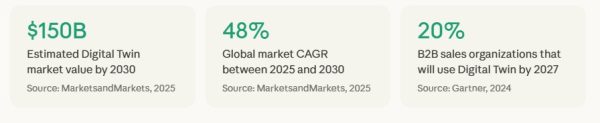
According to Gartner, by 2027 20% of B2B organizations will deploy digital twins to improve revenue generation and customer experience — simulating, anticipating, and personalizing every market interaction. We are still at the beginning of this transition. Those who move now aren't chasing the trend: they're defining it.
Why the product catalogue no longer closes industrial deals
Selling industrial technology almost always means selling something invisible: a plant that hasn't been built yet, a future performance, an efficiency the customer hasn't experienced. The catalogue isn't enough. Technical datasheets aren't enough. And presentations, however polished, still leave the decision-maker to imagine — with all the risks that entails during negotiation.
Companies selling complex technology often find themselves having to justify the value of their product with words. The Digital Twin allows them to move from words to evidence.
McKinsey, Unlocking the industrial potential of digital twins — 2024
McKinsey research documents that digital twins can cut development times by up to 50%, improve order fulfilment by 20%, and reduce labour costs by 10%. When these numbers are made visible and verifiable during a commercial negotiation, they fundamentally change the nature of the sales conversation.
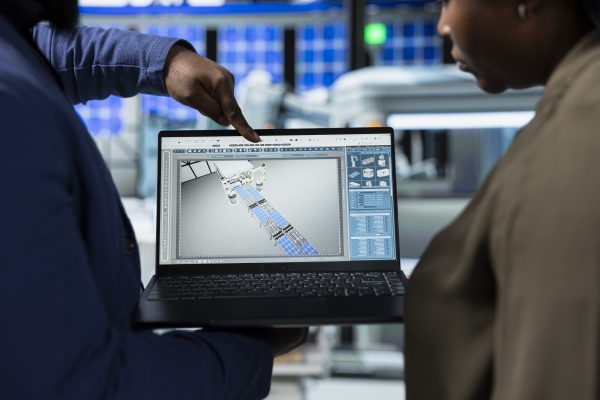
Four things simulation does that PowerPoint never will
- Tailored scenarios: The plant adapts to the customer's actual spaces, workflows and constraints — in real time, right in front of their eyes. No approximations, no leaps of faith.
- The invisible made visible: Heat flows, casting speeds, mechanical stress: phenomena normally hidden become fully explorable in virtual reality, even at a trade show.
- ROI verified on the spot: Real technical data integrated into the simulation turns a quote into a concrete business case. The customer doesn't "believe" in the ROI — they see it calculated.
- A pre-qualified lead: Someone who has interacted with the simulation isn't a cold contact: they're a prospect who already understands the technical value and has asked specific questions.
From Boeing to Properzi: who's already doing it and what they're getting
This isn't a theoretical hypothesis. Some of the world's largest industrial companies have already integrated the Digital Twin into their sales and product cycle, with measurable results.
- Boeing — Aerospace: Uses digital twins across the full aircraft lifecycle, from design to maintenance. Siemens documents production time reductions of up to 50% through digitalisation integrated into Boeing's processes.
- Rolls-Royce — Engine manufacturing: Digital twins of jet engines allow maintenance needs to be predicted based on real-time performance data — and sold to customers as a service, not a cost.
- Siemens — Manufacturing and infrastructure: With the Xcelerator platform and the Siemensstadt Square project (Berlin, €750M), Siemens uses digital twins to demonstrate value to institutional clients before a single brick is laid.
- Continuus Properzi — Metallurgy: World leader in non-ferrous metal production lines, the company developed an interactive Digital Twin experience for international trade shows: customers step virtually into the plant, adjust parameters and watch performance transform in real time.
Case study Properzi: when the trade show becomes a virtual testing room
Continuus Properzi's challenge is emblematic of a widespread problem in heavy industry: how do you communicate the excellence of monumental production lines — for lead, copper and aluminium — to decision-makers spread across the globe, often with no possibility of visiting a real plant?
The answer wasn't a better-looking 3D model. It was an interactive Digital Twin experience in which the prospective customer is not a spectator: they step virtually into the foundry, act on real variables and watch performance improve in real time through data visualisation interfaces. Technical KPIs become immediate charts, not catalogue promises.
The so-called "Haptic Bridge" — the synchronised handover of a card from the virtual to the physical world — serves to anchor the brand in memory. But it is the solidity of the simulation that delivers something far more valuable to the sales team: a lead who has already grasped the proposed technological value and asked specific questions. Not a contact. An informed counterpart.
Fewer objections, shorter cycle: what happens when customers stop imagining
The Digital Twin tackles the root cause of delays in industrial negotiation: the customer's uncertainty. When the decision-maker stops imagining and starts seeing — testing limits and potential in a simulated environment — objections turn into questions. And questions accelerate decisions.
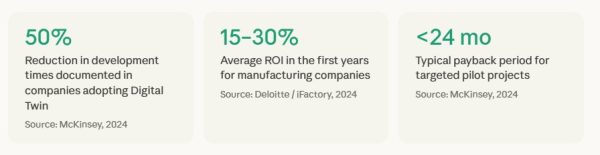
These figures relate to the operational impact of the Digital Twin. But when they are brought into the sales process — when the customer sees them generated in real time on their specific configuration — they become the most powerful closing tool a sales manager can have.
This is not an aesthetic exercise. It is a pragmatic positioning choice: giving the sales force the most powerful instrument available to demonstrate the company's engineering superiority in a way that is simple, clear and irrefutable.