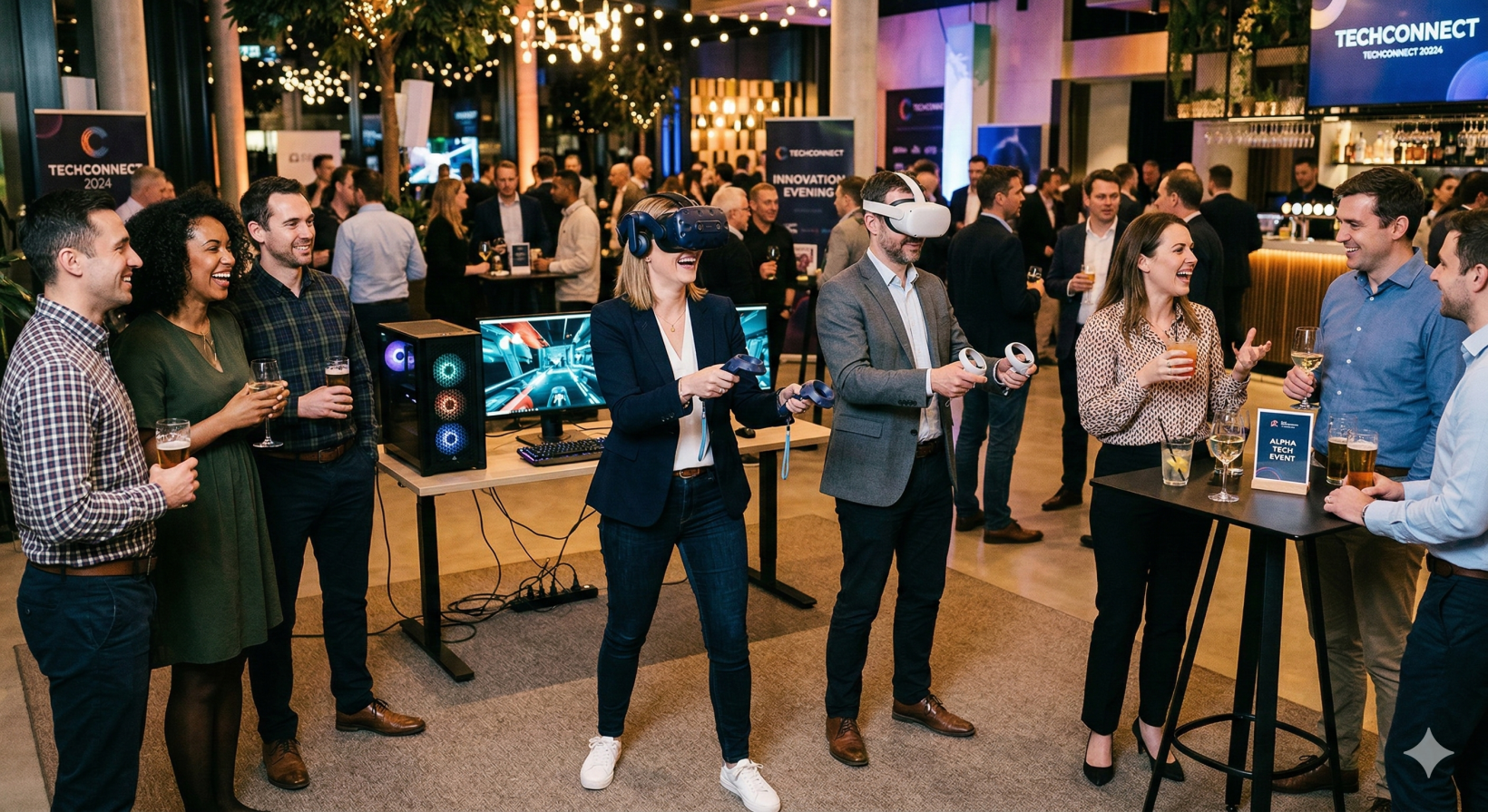
The future of corporate events is immersive (and involves gaming)
In recent years, corporate events have undergone a profound transformation. Once strictly informative or celebratory occasions—often experienced passively by the audience—they are increasingly becoming experiences designed to engage, activate, and leave a lasting impression on participants.
In this landscape, immersive technologies and gamification are not just passing trends; they are strategic tools for completely rethinking how companies communicate, train, and build relationships.
The Limitation of Traditional Events: Spectators, Not Participants
Conferences, conventions, and corporate meetings too often follow a familiar and now obsolete blueprint: a central stage, endless front-facing presentations, and an audience sitting in the dark, listening. While this format works for one-way information delivery, it struggles to generate emotional engagement or long-term memory.
The result is often frustrating:
- Attention spans drop drastically after the first few minutes.
- Key messages are not fully internalized.
- Minimal space is left for interaction and active learning.
This is precisely where technological innovation comes into play.

Immersive Technologies: From Content to Experience
Virtual Reality (VR), Augmented Reality (AR), and interactive digital environments allow events to be transformed into experiential spaces where participants stop observing and start acting. The event is no longer just a physical location, but an ecosystem of experiences designed around corporate objectives.
Thanks to immersive technologies, it is possible to:
- Explore virtual environments and scenarios that would otherwise be inaccessible.
- Simulate processes, products, or complex situations in total safety.
- Transform Storytelling (telling a story) into Storyliving (living the story).
Gamification: The Engine of Engagement
Gamification provides the rhythm, motivation, and meaning behind the immersive experience. It’s not about "playing for the sake of playing," but about applying typical gaming dynamics—timed challenges, objectives, instant feedback, and leaderboards—to professional contexts.
Within a corporate event, gamification serves to:
- Guide participants through paths of discovery.
- Transform complex or dry content (such as historical data and dates) into intuitive challenges.
- Incentivize networking and healthy competition among colleagues.
A Practical Example: The Tavola S.p.A. Case Study
To understand how these theories translate into reality, let’s look at the project developed for Tavola S.p.A. for their corporate event. The challenge was to recount the company’s evolution, from its founding to the present day, while avoiding the boredom of classic institutional presentations.
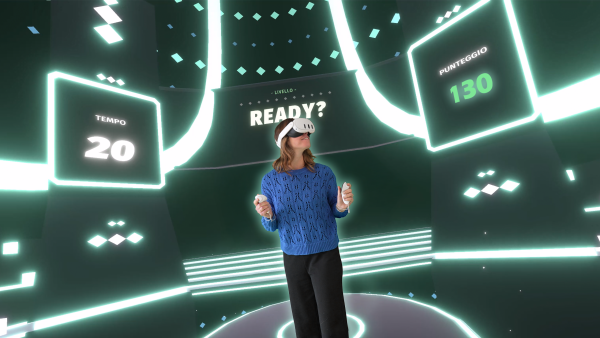
The solution was a VR experience that turned the brand’s history into an interactive video game. Immersed in a virtual hall, participants didn’t just "read" dates; they "played" them. Each level represented a historical era—such as 1964, the year the Little Trees (Arbre Magique) air freshener was first imported—and required users to hit specific targets to score points within a time limit. In this way, typically dry information like turnover figures or launch dates became objectives in an engaging challenge, making employees active protagonists and ensuring a vivid, lasting memory of company values.
Strategy Over Technology: It’s the Project That Matters
The success of cases like Tavola demonstrates that true value lies not in the technology itself, but in how it is designed. An effective immersive event is always born from three fundamental steps:
- Analysis of business objectives.
- Deep understanding of the target audience.
- Experience Design (UX) well before choosing the hardware.
Without a clear vision, VR and gamification risk becoming mere temporary "special effects." With solid planning, they become high-value strategic tools capable of training and uniting teams.
Conclusion: The Future is Participatory
The future of corporate events isn’t built on larger stages or flashier slides, but on participatory experiences where people are at the heart of the action. Immersive technologies and gamification represent the most powerful tools available today to engage, communicate, and create real value. It’s not about following a trend; it’s about rethinking the very meaning of coming together as a company: remembering what was lived, not just what was heard.