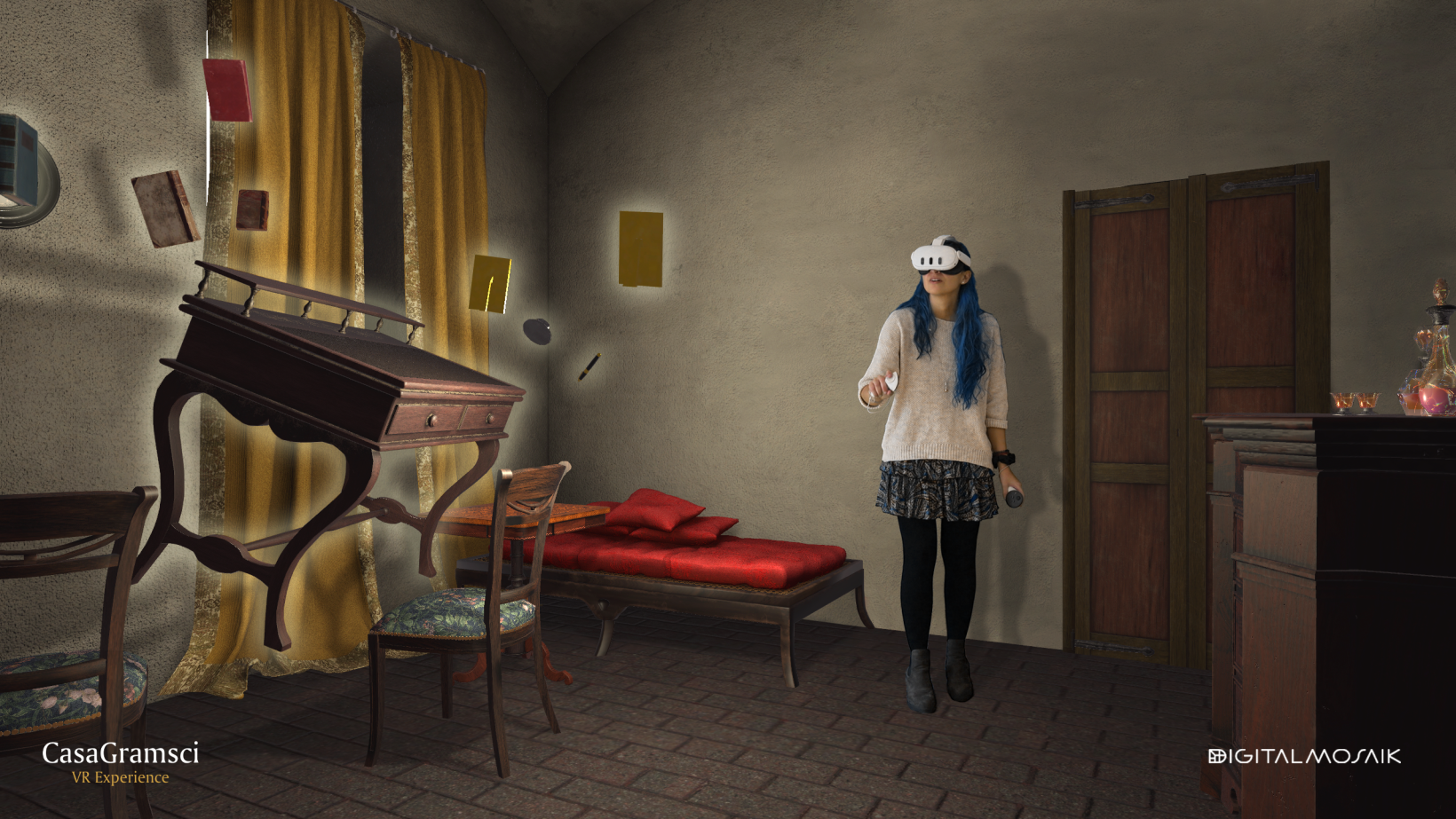
Can technology bring culture to life?
Imagine stepping across the threshold of a house that no longer exists.
Before you, the rooms of a poet unfold — the objects of his everyday life, pages scattered with hastily written verses, the silence that inspired creation.
Or picture yourself walking through the basalt stone walls of a Sardinian home, guided by the voice of one of the great thinkers of the twentieth century, as he recalls memories from his childhood.
This is not a daydream — it’s the power of immersive technologies, which are transforming the way we experience and transmit culture.
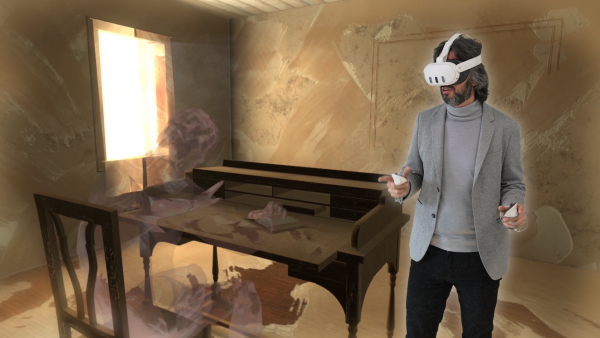
Technology as a Bridge Between Past and Present
Museums, archives, and cultural institutions hold treasures of immeasurable value — yet they are often inaccessible: closed spaces, fragile documents, unseen collections, unreachable places.
Today, virtual reality (VR) and augmented reality (AR) make it possible to reopen these doors, turning what is distant or lost into a living, shareable experience.
Immersive technologies don’t merely replicate what exists — they add new layers of meaning.
They allow us to listen, interact, and connect with stories; they give shape to emotions, rebuild spaces and atmospheres, and engage visitors in a narrative where culture becomes a personal, sensory, and participatory experience.
In this way, the digital world doesn’t replace the physical one — it amplifies it, creating new pathways to cultural heritage: more accessible, more inclusive, more emotionally engaging.
A New Language for Culture
Culture is made of memories, voices, and places.
The challenge today is not only to preserve them but to keep them alive and accessible to new generations. Immersive technologies meet this need perfectly: they speak the language of the young, weaving together storytelling and interaction, emotion and knowledge.
In museums and cultural spaces, an immersive experience is no longer just a multimedia addition — it’s a new form of cultural mediation.
It breaks down physical and social barriers, engaging audiences who might not have felt represented in traditional exhibitions.
At the same time, it provides scholars, curators, and institutions with powerful new tools to interpret and present complex heritage in more intuitive and participatory ways.
The result is an augmented culture — no longer confined to display cases or books, but alive, emotional, and capable of dialoguing with the present.
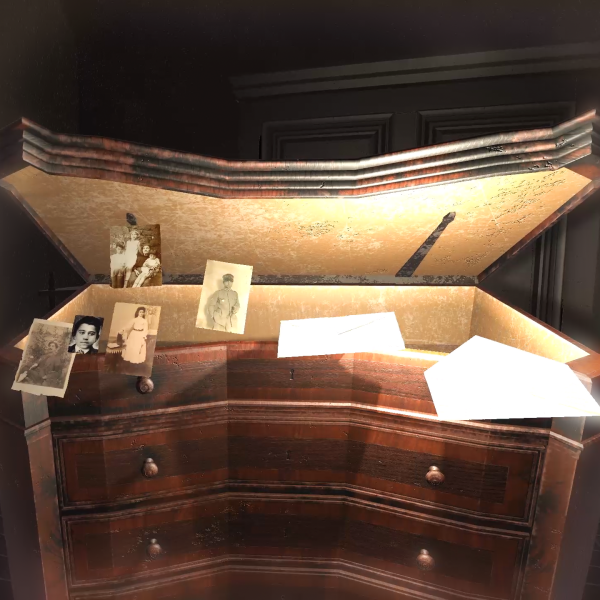
Two Examples of Immersive Memory: Zanella VR and CasaGramsci VR
Two emblematic projects — Zanella VR and CasaGramsci VR Experience — demonstrate how virtual reality can give voice and space back to memory.
Both show how digital innovation can become a bridge between eras and generations, bringing back to life the places and ideas that shape our cultural identity.
Zanella VR: Stepping Into Poetry
With Zanella VR, poetry is not just something you read — it’s something you live.
The experience allows visitors to explore the poetic universe of Giacomo Zanella inside his birthplace — a house now privately owned and inaccessible, but digitally reconstructed in every detail.
Walking through its rooms, visitors feel the poet’s presence: the spaces that inspired his verses become immersive environments where words take on physical form.
In this way, memory turns into shared emotion, making tangible what once existed only on the written page.
👉 Discover more about Zanella VR
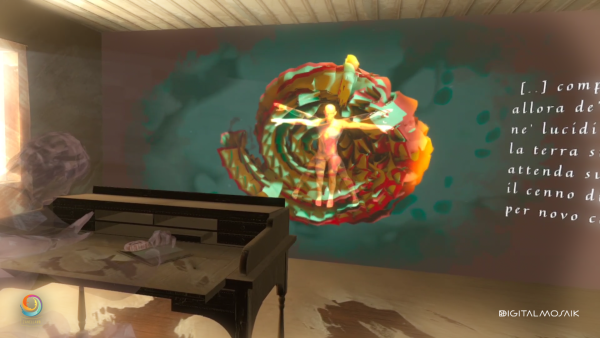
CasaGramsci VR: Meeting a Thinker
The Antonio Gramsci House Museum in Ghilarza now opens its doors even to those who cannot visit in person.
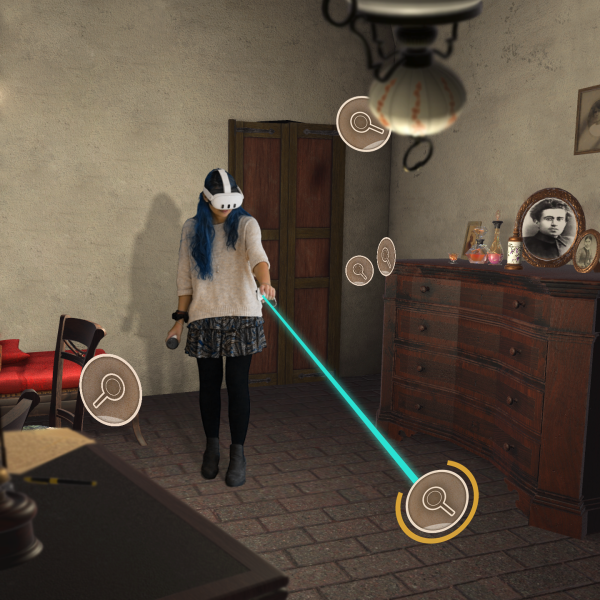
With CasaGramsci VR Experience, the museum journey expands into an interactive, multisensory story: among basalt stone walls, original furnishings, documents, and photographs, visitors move through a realistic, enveloping space.
Here, technology becomes a tool for inclusion and remembrance: vanished objects are virtually restored, forgotten stories are brought back to life.
Through intuitive interactions and guided narration, visitors immerse themselves in Gramsci’s world, discovering a new, intimate side of one of the twentieth century’s greatest intellectuals.
👉 Discover more about CasaGramsci VR
The Future of Cultural Experience
Projects like Zanella VR and CasaGramsci VR show that technology is not a replacement — it’s a form of continuity.
It allows us to preserve and transmit heritage in new, open, and sensory ways — ways that move, educate, and inspire.
In a world where the boundaries between real and digital grow ever thinner, culture finds a new home: the realm of living experience.